.png)


Keeping high-profile guests secure: the full picture

TL;DR:
Effective high-profile guest security relies on layered protection, advance intelligence, and adaptive planning, not visible force.
Proper zoning, vetted transport, and real-time threat updates are essential to minimize risks and ensure seamless protection.
Effective high-profile guest security is defined as a dynamic, layered protection system that integrates advance intelligence, controlled zoning, and adaptive threat response. It is not a visible perimeter or a headcount of uniformed personnel. The industry term for this discipline is executive protection, and it operates on a principle that most event planners underestimate: presence is not protection. What it actually takes to keep high-profile guests secure is a coordinated process built well before the first guest arrives, one that accounts for venue vulnerabilities, transport corridors, and the human factors that no checkpoint alone can address.

How does advance planning shape VIP security outcomes?
The gap between effective executive protection and security theatre is almost always visible in the planning phase. Advance work covering venue reconnaissance, route planning, communications setup, and contingency triggers is what separates a protected principal from a well-guarded liability. Without it, teams improvise under pressure, and improvisation in high-stakes environments produces failures.
Effective advance planning for high-profile guest security covers several non-negotiable elements:
Venue reconnaissance: Security teams must map entrances, exits, and blind spots before doors open. This establishes situational awareness that cannot be built on arrival.
Route planning: Primary and secondary routes for the principal’s movement are confirmed in advance, accounting for traffic, crowd density, and known threat corridors.
Role delineation: Every team member knows their specific function. Ambiguity in roles during an incident is a direct operational risk.
Secure communications: Encrypted radio channels and pre-agreed code language reduce the chance of information being intercepted or misunderstood under pressure.
Contingency plans: Plan B is not optional. Adaptive threat detection requires pre-built response frameworks that activate without deliberation.
Intelligence updates during the event lifecycle are equally critical. A threat profile that was accurate at 9am may be outdated by noon. Security leads must maintain live feeds from local law enforcement and venue management throughout the event.
Pro Tip: Brief all security staff on de-escalation protocols before the event. Calm, discreet intervention prevents minor confrontations from becoming incidents that compromise the principal’s position.
What does access control actually look like for high-profile events?
Access control in executive protection is built on the concept of layered zoning, specifically the distinction between “clean” and “dirty” spaces. A clean space is a screened, controlled area where only vetted individuals are permitted. A dirty space is any area accessible to the general public or unscreened attendees. The objective is to minimise the principal’s exposure to dirty spaces entirely.
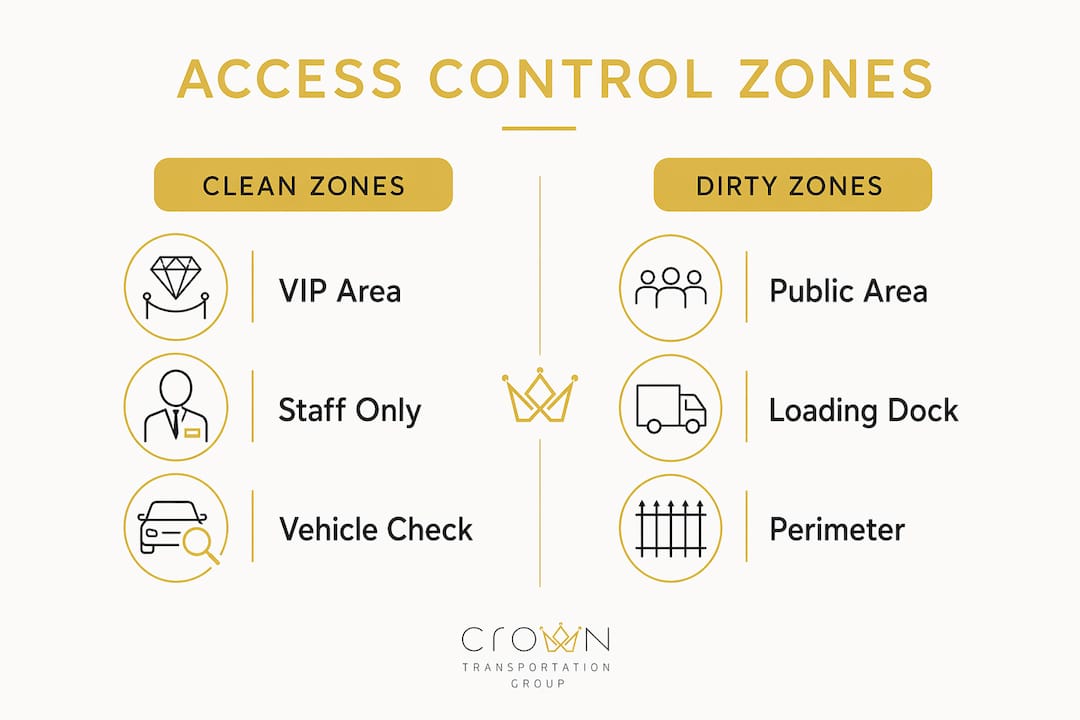
The White House Correspondents’ Dinner provides a well-documented case study. The Washington Hilton hosts both the event and general hotel guests, creating a zoning challenge that security teams resolve through magnetometers, controlled corridors, and hard separation between the ballroom footprint and public hotel areas. The lesson is that even a partially public venue can be secured effectively when zoning is applied with discipline.
Access control method | Application and purpose |
Magnetometer screening | Entry to clean zones; detects prohibited items before guests reach the principal |
Credentialling and badging | Identifies authorised personnel across all event phases |
Hard perimeter closures | Restricts vehicle and pedestrian access around the venue footprint |
Chokepoint management | Funnels movement through monitored transition points between zones |
Dynamic posture adjustment | Shifts focus from entry screening to perimeter control once the event is underway |
Security posture changes across the event lifecycle are expected and planned for. Screening intensity at entry is highest before the event begins. Once the principal is inside a secured clean zone, the priority shifts to perimeter integrity and movement control.
Pro Tip: Assign a dedicated zoning coordinator whose sole responsibility is monitoring transitions between clean and dirty spaces. This role is frequently overlooked and consistently undervalued.
How does transport security integrate with overall VIP protection?
Ground transportation is one of the most exposed phases of any high-profile visit. The principal is mobile, the route is partially predictable, and the vehicle is a known target. This is why VIP transportation planning is treated as an extension of the event security plan, not a separate logistical function.
Effective transport security for high-profile guests follows a structured sequence:
Vehicle vetting: All vehicles in the motorcade or transfer fleet are inspected before use. Mechanical integrity and sweep for tracking devices are standard.
Driver and chauffeur screening: Transport personnel are background-checked and briefed on security protocols, including communication procedures and emergency egress routes.
Route confirmation: Primary and alternate routes are confirmed with local authorities. Hard closures, such as bag bans and vehicle restrictions around high-risk venues, are coordinated in advance.
Arrival and departure timing: Exact arrival windows are kept to a minimum number of people. Predictable timing is a vulnerability.
Handover protocols: The transition between vehicle and venue is a high-exposure moment. A defined handover procedure with security personnel on both sides reduces risk at this juncture.
Corporate executives and event planners who understand why private chauffeurs are preferred for high-profile transfers recognise that the vehicle is a mobile secure zone, not simply a mode of transit. The chauffeur’s training, discretion, and route knowledge are part of the protection architecture.
What are the biggest misconceptions about high-profile guest security?
The most persistent misconception in event security for VIPs is that a visible, imposing security presence signals effective protection. It does not. Heavy visible presence can escalate tension, attract unwanted attention, and paradoxically increase the principal’s exposure by advertising their location and importance.
Several other misconceptions create operational risk:
Single-point screening is sufficient: One checkpoint at the main entrance does not account for service entrances, loading docks, or credentialled staff who bypass standard screening.
Static plans are reliable: Security plans must adapt to new threat intelligence during the event. A plan that cannot flex is a plan that will eventually fail.
Technology replaces process: Surveillance cameras and access card systems support security. They do not replace trained personnel, clear protocols, and a comprehensive event security checklist that covers risk assessment, emergency response, and staff training.
The principal’s team handles everything: Event planners and venue staff are part of the security architecture. Siloing the protection team from event operations creates blind spots.
Balancing public openness with controlled zoning in semi-public venues remains one of the most demanding challenges in safeguarding high-profile visitors. The solution is not to lock everything down. It is to design the event footprint so that the principal never needs to enter an uncontrolled space.
Key takeaways
Effective high-profile guest security requires advance intelligence, disciplined zoning, adaptive planning, and vetted transport, not visible force or single-point screening.
Point | Details |
Advance planning is foundational | Venue recon, route confirmation, and contingency triggers must be locked in before the event begins. |
Zoning controls exposure | Separating clean and dirty spaces limits the principal’s contact with unscreened individuals. |
Transport is part of the plan | Chauffeur vetting, route planning, and handover protocols are security functions, not logistics afterthoughts. |
Visible presence can backfire | Discreet, process-driven protection reduces risk more reliably than an imposing security footprint. |
Plans must adapt in real time | Live intelligence updates and flexible response frameworks are non-negotiable for evolving threat environments. |
What experience has taught me about VIP security
I have seen event planners invest heavily in uniformed guards and access wristbands, then leave the loading dock unmonitored and the principal’s departure route unconfirmed. The security budget looked right on paper. The process was not.
The most effective protection operations I have observed share one quality: they are almost invisible. The principal moves without friction, the event runs without incident, and the security architecture is never the story. That outcome is not accidental. It is the product of meticulous advance work, clear role assignments, and a team that has rehearsed contingencies before they are needed.
What I find consistently undervalued is calm communication. De-escalation training for security personnel is not a soft skill. It is an operational capability that prevents minor confrontations from becoming incidents that compromise the entire protection plan. Invest in it.
— Chris
Secure transport for high-profile guests with Crown Transportation Group

Crown Transportation Group delivers premium chauffeur services purpose-built for high-profile clients, corporate executives, and event planners who require more than a vehicle. Every transfer is planned with the same advance rigour that executive protection demands: vetted drivers, confirmed routes, and discreet handover protocols that integrate with your broader security framework. Whether you are coordinating event logistics in Sydney or managing a multi-city VIP itinerary, Crown Transportation Group provides the ground transport layer your security plan cannot afford to overlook. Contact the team to discuss a tailored solution for your next high-profile event.
FAQ
What is the difference between executive protection and event security?
Executive protection focuses on the safety of a specific individual, covering advance planning, transport, and close protection. Event security manages the broader venue, crowd, and access control environment that surrounds the event.
How far in advance should VIP security planning begin?
Planning for high-profile guest security should begin weeks before the event. Venue reconnaissance, route confirmation, and intelligence briefings require time that cannot be compressed without introducing risk.
Why is visible security presence not always effective?
Heavy visible security can signal the principal’s location, escalate crowd tension, and create a false sense of protection. Discreet, process-driven protection consistently produces better outcomes than an imposing security footprint.
What role does transport play in VIP security?
Ground transport is one of the highest-exposure phases of any high-profile visit. Vetted drivers, inspected vehicles, confirmed routes, and defined handover protocols are all security functions that must be coordinated with the event protection plan.
What is the clean versus dirty space concept in event security?
A clean space is a screened, access-controlled area where only vetted individuals are permitted. A dirty space is any area accessible to the general public. Effective VIP security minimises the principal’s time in dirty spaces entirely.
Recommended


Comments