.png)


Event logistics in Sydney: the operational blueprint
Updated: Jun 1

Effective Sydney event logistics require a multi-phase, interconnected approach that emphasizes early planning, regulatory compliance, and precinct clustering. Avoid interface failures by aligning transport, crowd safety, and licensing strategies before finalizing venue layouts, ensuring seamless execution. Utilizing local resources like BESydney and partnering with reliable transport providers like Crown Transportation Group can enhance coordination and reduce logistical risks.
Most event planners treat logistics as a checklist. That assumption is where high-profile events in Sydney begin to unravel. A guide to seamless event logistics in Sydney must reckon with something more demanding: a multi-layered operational design that spans regulatory compliance, precinct geography, transport synchronisation, and crowd safety law. Get any single layer wrong and the consequences ripple across every other. This guide gives you the frameworks, the regulatory specifics, and the hard-won sequencing that separates a controlled event from a costly failure.
Table of Contents
Key takeaways
Point | Details |
Plan in three distinct phases | Structure every logistics task across pre-event, event day, and post-event phases to prevent gaps between load-in and pack-down. |
Engage council early | Transport Management Plans and road closure approvals in NSW require proactive council engagement well before event day. |
Lock in liquor licensing first | NSW pop-up licence categories set patron limits and bar layouts, so decide early to avoid redesigning your entire liquor plan. |
Cluster your precinct | Placing hotels, venues, and transport hubs within one precinct is the highest-return strategy for delegate flow in Sydney CBD events. |
Integrate TMP and crowd plans | Treat your Traffic Guidance Scheme and crowd capacity controls as one connected system, not two separate documents. |
The three phases of event logistics management
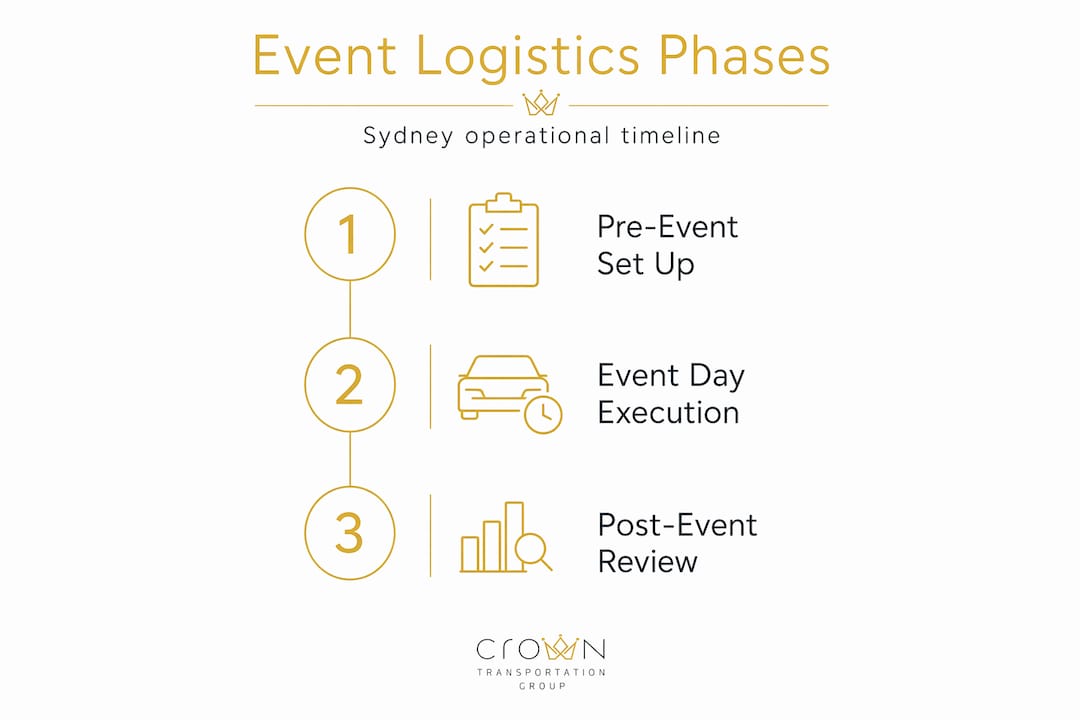
The industry term for what most planners call “event coordination” is event logistics management, and it has a formal structure. Good logistics practice organises every operational task into three phases: pre-event, event day, and post-event. Each phase is interdependent. A failure in one creates compounding problems in the next.
Pre-event phase. This covers venue sourcing, supplier contracting, equipment procurement, registration setup, transport planning, and permit applications. For a Sydney event of any scale, this phase should begin six to twelve months out. Council engagement, Transport Management Plans (TMPs), and liquor licence applications all have fixed lead times that cannot be compressed.
Event day phase. This is active logistics management in real time: load-in, bump-in sequencing, delegate arrival flows, session changeovers, catering delivery windows, and security deployment. Aligning stakeholders across phases is what separates smooth execution from reactive firefighting. Every supplier needs a call sheet, not just a brief.
Post-event phase. Pack-down, equipment returns, venue reinstatement, supplier invoicing, and debrief surveys. This phase is where most organisers lose discipline. Departures for VIPs and interstate delegates need the same transport coordination as arrivals.
Pro Tip: Build a master run sheet that maps every supplier’s on-site window against the venue’s bump-in and bump-out schedule. Overlaps here are the single most common cause of load-in delays in Sydney CBD venues.
Treat these phases as a connected sequence, not three separate to-do lists. Operational design reduces event day failures by aligning stakeholders to interlinked logistics phases, not simply scheduling tasks in isolation.
Regulatory requirements you cannot afford to miss
Sydney’s event planning environment is genuinely complex at the regulatory level. Understanding which approvals you need, and when to apply, is non-negotiable for any planner executing a high-profile event.
Transport Management Plans and road closures
Events impacting public roads in NSW require council engagement and, in most cases, a formal TMP. This document specifies Traffic Guidance Schemes (TGS), road closure details, alternative pedestrian and vehicle routes, parking arrangements, and contractor responsibilities. The TMP is not a formality. It determines your bump-in access windows, supplier vehicle movements, and emergency vehicle corridors.
Local councils require early engagement to avoid delays and compliance failures. For larger-scale closures, allow a minimum of three months. Smaller permits may move faster, but never assume.
Liquor licensing distinctions
This is where organisers consistently underestimate the timeline. NSW operates distinct licence categories with very different conditions:
Pop-up bar licence: Maximum 100 patrons on premises at any time. Applications must be lodged at least 28 days prior to the event.
Pop-up event licence: Permits up to 300 patrons, with different approval timing and conditions that affect bar placement and security staffing ratios.
The licence category you choose shapes your entire bar layout, patron flow design, and security roster. Decide before you finalise the floor plan, not after.
Crowd safety obligations
Event organisers in Sydney bear primary legal responsibility for crowd safety under the Work Health and Safety Act 2011. This includes documented risk management plans, compliant security staffing levels, and adherence to all council permit conditions. These obligations sit with the organiser, not the venue.
Strategic transport and venue logistics
Sydney’s CBD geography is one of its greatest logistical advantages. The compact precinct structure reduces delegate movement friction significantly when you plan around it deliberately.
Transport consideration | Recommended approach |
Airport arrivals | Allow buffer time. The Airport Link train runs to Central Station in approximately 13 minutes, but crowding at peak periods adds variance. |
Delegate hotel clustering | Place all delegate accommodation within one precinct to eliminate cross-city transfers during programme days. |
Venue and transport hub proximity | Prioritise venues within walking distance of Town Hall, Central, or Circular Quay stations. |
Accessible transport | Confirm lift access and accessible parking at both venue and accommodation before contracting. |
Supplier vehicle management | Map every supplier arrival window against TMP corridor access to prevent conflicts. |
BESydney’s Event Planning Hub provides budgeting tools, supplier contact networks, feasibility frameworks, and Sydney-specific logistics guidance that is genuinely useful for large congress and corporate event planning. Use it early in the pre-event phase, not as a last resort.
Pro Tip: When coordinating airport arrivals for VIP delegates, pre-assign a named contact for each arrival rather than using a generic “meet and greet” instruction. This eliminates confusion at the international terminal and removes a pressure point on event day.
When arranging professional chauffeur transfers for delegates requiring accessible vehicles or specific routing, confirm capacity and compliance at the booking stage rather than assuming standard fleet configurations apply.
Crowd management and security integration
Your crowd management plan is a legal document as much as it is an operational one. Structure it around these core components:
Venue layout and capacity enforcement. Define hard capacity limits for each zone, assign staff to enforce them, and brief security on escalation triggers before doors open.
Security staffing and role assignments. Match staffing ratios to your licence conditions and risk assessment. Assign specific roles: entry screening, floor monitoring, incident response, and VIP escort.
Emergency procedures and escalation protocols. Every team member needs a laminated one-page card with emergency contacts, evacuation routes, and the chain of command. Test it in the pre-event briefing.
Liquor licence alignment. Your security plan must be consistent with your licence category’s patron limits and conditions. A discrepancy between your crowd plan and your licence is a compliance exposure.
Security provider engagement. Treat your security company as a planning partner, not a day-of contractor. Brief them on the venue layout, the crowd profile, and the VIP movements at least a week out.
The most common gap in Sydney event crowd plans is the interface between the TMP scope and the crowd capacity controls. Treating these as integrated planning tasks prevents the scenario where road closure corridors conflict with your designated entry and exit flows.
Post-event logistics and continuous improvement
The wrap-up phase deserves the same operational rigour as load-in. Specifically:
Coordinate pack-down against the venue’s reinstatement schedule and any remaining TMP access windows.
Arrange dedicated transport for VIP and staff departures, with the same precision applied to arrivals. Consider airport transfer services pre-booked against departure flight times.
Distribute post-event surveys within 24 hours while the experience is fresh for delegates and suppliers alike.
Conduct a structured debrief with your core team within the week, focused on interface failures rather than general impressions.
Compile a logistics report capturing ROI metrics, stakeholder feedback, and a ranked list of process improvements for the next event.
The debrief is where the real logistics intelligence lives. Use it.
My perspective on Sydney event logistics
I’ve seen well-resourced events fall apart in Sydney not because of budget shortfalls or inexperienced teams, but because of interface failures. The bump-in timing clashes with the road closure approval window. The TMP corridor conflicts with the crowd entry flow. The liquor licence category was chosen after the floor plan was locked, forcing a costly redesign two weeks out.
What I’ve learned from coordinating high-profile events in this city is that the single precinct strategy genuinely transforms execution quality. When delegates, accommodation, and transport hubs sit within one walkable cluster, your logistics surface area shrinks dramatically. You’re managing flow, not distance.
My strongest advice: make your liquor licensing and TMP decisions before you finalise any venue layout. These two elements constrain everything else, and treating them as downstream approvals is where the expensive surprises come from. Engage your council contact as a planning collaborator from day one.
— Chris
How Crown Transportation Group supports your event
When your event logistics plan demands transport precision, Crown Transportation Group delivers the operational reliability that high-profile Sydney events require. From coordinated airport transfers synchronised with flight arrivals to point-to-point chauffeur services for VIP delegates and corporate principals, Crown Transportation Group integrates directly with your event schedule. The fleet covers delegate movements, staff transfers, and VIP escort runs across Sydney’s CBD precincts. For event planners who need a ground transport partner as disciplined as their own team, Crown Transportation Group is the standard.
FAQ
What is a Transport Management Plan in NSW?
A Transport Management Plan (TMP) is a formal document required for events that impact public roads in NSW. It covers traffic guidance schemes, road closures, parking, and pedestrian management, and must be prepared in consultation with the relevant local council.
How early should I apply for a pop-up liquor licence in Sydney?
NSW pop-up liquor licence applications must be lodged at least 28 days before the event. The licence category you choose, either pop-up bar (100 patrons max) or pop-up event (300 patrons max), determines your bar layout and security requirements.
Who is legally responsible for crowd safety at Sydney events?
Under the Work Health and Safety Act 2011, the event organiser bears primary legal responsibility for crowd safety. This includes documented risk management plans, appropriate security staffing, and compliance with all council permit conditions.
How do I optimise delegate transport in Sydney’s CBD?
Cluster your hotels, venues, and transport hubs within a single precinct where possible. Sydney’s compact CBD and the Airport Link train, which connects the airport to Central Station in around 13 minutes, support efficient delegate flow when planned around these connections.
What tools are available for event planning in Sydney?
BESydney’s Event Planning Hub offers budgeting tools, supplier networks, feasibility frameworks, and Sydney-specific logistics guidance tailored to business events and large congresses. It is a practical resource for planners at the early stages of event design.
Recommended

Comments