.png)


How premium transport partners are graded: strict criteria

TL;DR:
Grading premium transport partners involves assessing performance metrics, legal compliance, and continuous monitoring to ensure operational reliability. Reliable on-time delivery, safety, and insurance standards determine eligibility, with tiered segmentation assigning volume and priority based on verified data. Maintaining transparent relationships and adaptive scorecards allows organizations to reduce risks and secure capacity during high-demand periods.
The strict criteria used to grade premium transport partners are defined performance and compliance benchmarks that determine whether a provider is trusted with high-profile corporate travel or removed from consideration entirely. For travel managers, corporate decision-makers, and event planners, selecting the wrong partner carries real financial and reputational risk. The evaluation framework used by leading organisations covers on-time delivery rates, insurance thresholds, safety metrics, and tiered segmentation. Understanding these standards gives you the authority to make selection decisions that hold up under scrutiny.
What performance metrics are crucial when grading premium transport partners?
On-time delivery rates are the single most weighted metric in any premium transport evaluation, accounting for 20 to 25% of the total scorecard. Failure to maintain a 90 to 95% on-time rate triggers probation or disqualification from preferred partner programmes. This threshold exists because even a 5% deviation across a high-volume corporate account translates to dozens of missed connections, delayed executives, or disrupted event logistics per year.

Detention time and damage rates complete the core operational picture. Partners are typically held to detention times under one hour and damage rates below 1%. These figures are not arbitrary. Detention time above one hour signals poor scheduling discipline, while damage rates above 1% indicate inadequate vehicle maintenance or handling protocols.
KPI | Target threshold | Consequence of failure |
On-time delivery | 90–95% | Probation or disqualification |
Detention time | Under 1 hour | Performance review |
Damage rate | Below 1% | Immediate audit |
Tender acceptance rate | Above 90% | Renegotiation of terms |
Pro Tip: Track KPI trends over rolling 90-day periods rather than monthly snapshots. A partner who scores 94% on-time in month one but drops to 88% by month three is showing deterioration, not stability. Trend data reveals the true reliability of a transport relationship far better than point-in-time scores.
When evaluating transport partner performance, these metrics collectively signal whether a provider operates with the discipline required for high-stakes corporate travel.
How do legal and risk-mitigation criteria influence partner grading?
Insurance requirements are non-negotiable in any credible transport partner assessment. Insurance minimums of $1 million apply as a baseline, with high-value or sensitive lanes requiring coverage of $2 to $5 million. Continuous validity monitoring matters as much as the initial certificate. A policy that lapses mid-contract exposes your organisation to uninsured liability the moment an incident occurs.
Safety metrics add a second layer of legal protection. Screening checks Vehicle Maintenance BASIC percentiles, with scores below 75 considered acceptable, and Driver Fitness BASIC scores below 65. Interpreting these FMCSA percentiles requires context. Fleet size and inspection frequency affect scores significantly, so a small operator with a higher percentile may carry less actual risk than a large fleet with a marginally lower score.
Carrier authority verification protects against a specific and costly threat: chameleon carriers. These are operators who dissolve and reregister under new names to escape poor safety records. Verifying corporate ties, ownership history, and authority continuity is a standard step in any rigorous vetting process.
Essential legal and risk-mitigation checks include:
Confirm insurance certificates are current and meet minimum coverage thresholds
Screen Vehicle Maintenance BASIC percentiles and Driver Fitness BASIC scores
Verify carrier authority and check for corporate restructuring or name changes
Review FMCSA Safety Measurement System trends, not just current scores
Maintain a written vetting SOP with documented minimum criteria for legal defensibility
A documented vetting procedure is not just good practice. It is a legal defence strategy that reduces liability exposure in litigation and demonstrates due diligence to insurers and stakeholders.
What role does tiered segmentation play in grading and managing premium partners?
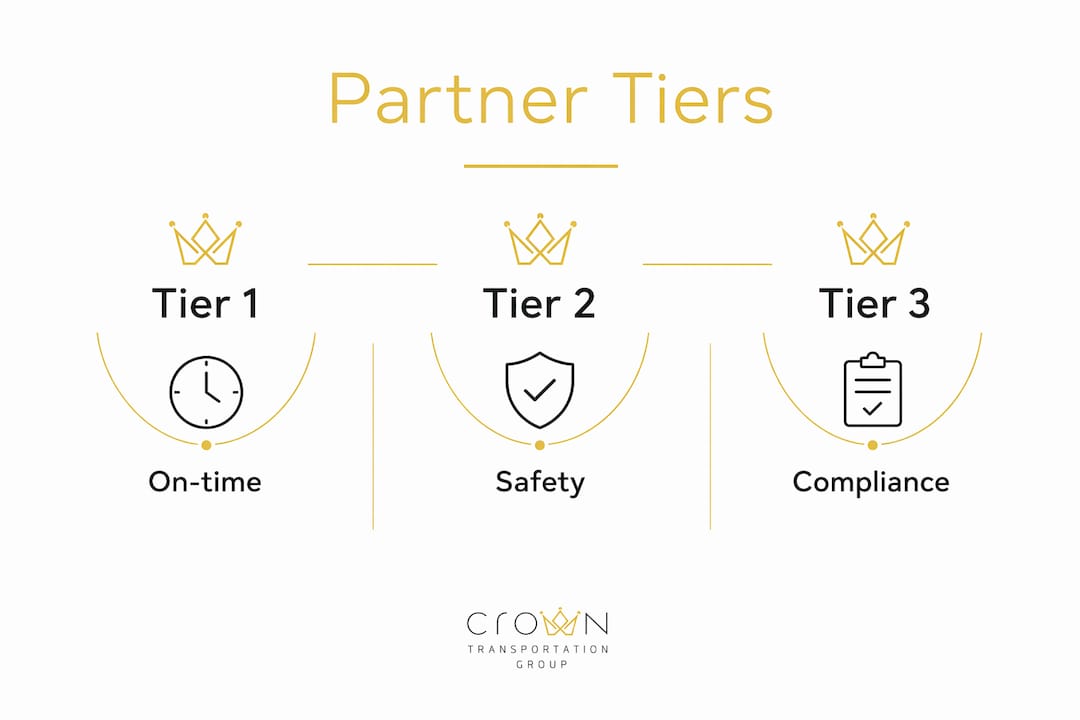
Tiered segmentation replaces subjective partner selection with a data-driven classification system that allocates volume and risk according to verified performance. Three-tier segmentation is the standard model, and it works as follows.
Tier | Partner profile | Volume allocation |
Tier 1 (top 15–20%) | Consistently exceeds KPI thresholds | Dedicated volume commitments and preferred lane access |
Tier 2 (middle 50–65%) | Meets baseline standards | Standard volume with performance improvement targets |
Tier 3 (bottom 20–30%) | Below threshold performance | Spot assignments only or formal improvement plans |
Organisations that rely on subjective selection rather than tiered data lose 8 to 12% in hidden service failures. That figure includes missed SLAs, emergency rebooking costs, and reputational damage from failed executive transfers. Tiering removes the guesswork and creates a transparent, defensible basis for every allocation decision.
The practical benefit extends to capacity management. Tier 1 partners receive volume certainty, which incentivises them to prioritise your account during peak demand. Tier 3 partners face clear consequences, which either drives improvement or accelerates their removal from the programme. For corporate travel managers overseeing executive transport in Sydney or other major hubs, this structure reduces service failures during high-stakes periods such as board meetings, investor roadshows, or large-scale events.
How can data-driven scorecards transform transport partner evaluation?
A carrier scorecard is a weighted evaluation tool that converts multiple KPIs into a single comparable score across all partners. The standard weighting structure allocates 40% to service performance, 25% to cost and billing accuracy, 20% to operational reliability, and 15% to compliance and safety. This structure reflects the reality that service consistency matters more than price in premium transport contexts.
Scorecards that are implemented well improve tender acceptance rates above 90% and reduce freight spend by 5 to 10%. The mechanism is straightforward: objective data replaces anecdotal impressions, and partners who know they are being scored consistently tend to perform more consistently.
Implementing a scorecard programme follows a clear sequence:
Define the KPIs relevant to your specific travel programme and risk profile
Assign weightings that reflect your organisation’s priorities, such as prioritising on-time performance for executive travel
Establish data collection processes, whether through a transport management system or manual reporting
Set review cycles, typically monthly for active partners and quarterly for strategic reviews
Communicate scorecard criteria to all partners before implementation to set clear expectations
Use automated alerts to flag partners who breach threshold scores between formal reviews
Pro Tip: Align your scorecard weightings with your actual business priorities rather than industry defaults. An event planning firm running time-critical delegate transfers should weight on-time performance at 50% or higher, not the standard 40%. Your scorecard should reflect your risk profile, not a generic template.
Logistics leaders consistently confirm that scorecards prioritise reliability over price, which is the correct orientation for any programme where service failure carries reputational consequences.
What are best practices for continuous monitoring and relationship management?
Initial vetting establishes a baseline. Continuous monitoring protects you from the gradual deterioration that initial checks cannot predict. Certificate-of-insurance expirations and FMCSA Safety Measurement System trends must be tracked on an ongoing basis, because risk profiles change as fleets age, staff turn over, and operational pressures mount.
The transport partner relationship is also reciprocal. Premium partners rank their clients to allocate capacity to preferred accounts during market volatility. Organisations that provide forecast accuracy above 80% and maintain payment cycles under 20 to 30 days earn preferred status and secure capacity when demand surges. This is a detail many travel managers overlook. Your behaviour as a client directly affects the service priority you receive.
Key relationship management factors that determine preferred client status:
Forecast accuracy above 80% to allow partners to plan resource allocation
Payment cycles under 30 days to signal financial reliability
Clear and timely communication of schedule changes or volume fluctuations
Regular performance review meetings that acknowledge partner improvements
Transparent escalation processes that resolve disputes without damaging the relationship
Key takeaways
Grading premium transport partners requires a structured framework combining quantitative KPIs, legal compliance checks, tiered segmentation, and continuous monitoring to protect operational reliability and reduce risk.
Point | Details |
Performance thresholds matter | On-time delivery must reach 90 to 95% or partners face probation or removal. |
Legal checks are continuous | Insurance validity and safety metrics require ongoing monitoring, not a single review. |
Tiered segmentation reduces failures | Organisations using subjective selection lose 8 to 12% in hidden service failures. |
Scorecard weightings should reflect your priorities | Align KPI weightings with your specific travel programme risk profile, not industry defaults. |
Reciprocal behaviour earns capacity | Forecast accuracy above 80% and timely payments secure preferred partner status during peak demand. |
What I’ve learned about grading transport partners that most guides won’t tell you
The most common mistake I see in transport partner assessment is over-reliance on surface metrics at the point of onboarding. Organisations invest heavily in initial vetting and then assume the work is done. The reality is that a partner who scores well in month one can deteriorate significantly by month six if no one is watching the trend data.
The second issue is the absence of a written vetting SOP. Without documented minimum criteria, every selection decision becomes a judgement call that is difficult to defend if something goes wrong. A written procedure protects the organisation legally and creates consistency across team members who may have different risk tolerances.
What actually works is treating the scorecard as a living document and the partner relationship as genuinely reciprocal. The organisations that secure the best service during high-demand periods are the ones who pay on time, communicate clearly, and treat their transport partners as strategic assets rather than interchangeable vendors.
— Chris
Crown Transportation Group: built to meet the standard

Crown Transportation Group operates to the performance and compliance standards this article describes. Every chauffeur in the Crown fleet is vetted against strict safety and professional conduct criteria, and every engagement is backed by appropriate insurance coverage and documented service protocols. For corporate travel managers and event planners who need a transport partner that holds up under scrutiny, Crown’s premium chauffeur service and point-to-point transfers are designed to deliver the reliability and professionalism your clients and executives expect. Contact Crown Transportation Group to discuss how the service can be structured around your specific programme requirements.
FAQ
What is the minimum on-time delivery rate for a premium transport partner?
Premium transport partners are expected to maintain on-time delivery rates of 90 to 95%. Falling below this threshold typically triggers a formal performance review or probation period.
How much insurance coverage should a premium transport partner carry?
The baseline insurance requirement is $1 million, with high-value or sensitive lanes requiring $2 to $5 million in coverage. Continuous monitoring of certificate validity is as important as the initial coverage amount.
What is tiered segmentation in transport partner management?
Tiered segmentation classifies partners into three groups based on verified performance data. Tier 1 partners receive dedicated volume commitments, while Tier 3 partners are assigned spot loads or placed on formal improvement plans.
Why do scorecards matter more than price when selecting transport partners?
Scorecards prioritise long-term reliability and risk reduction over short-term rate savings. Data-driven scorecards improve tender acceptance rates above 90% and reduce freight spend by 5 to 10% by removing anecdotal decision-making.
How does a shipper earn preferred status with premium transport partners?
Preferred status is earned by providing forecast accuracy above 80% and maintaining payment cycles under 30 days. Partners allocate their best capacity to clients who demonstrate operational predictability and financial reliability.
Recommended


Comments